The Offida Approach: Entrepreneurial Education
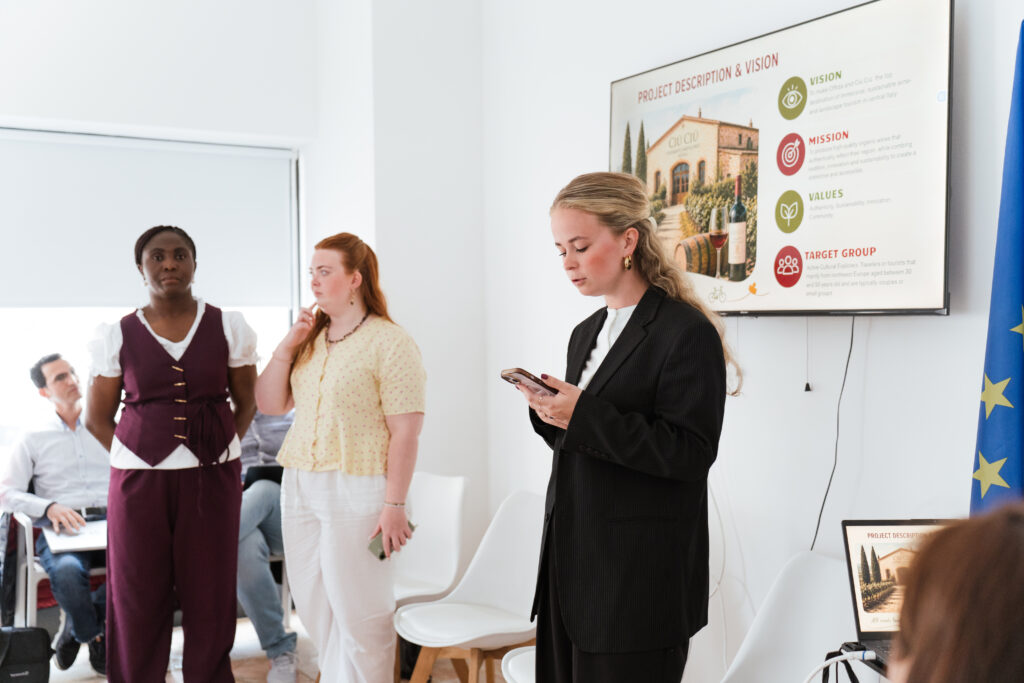
Entrepreneurial education is not learned by memorizing business theories. Instead, students learn by solving real problems. They work with companies, test new ideas and build practical solutions. As a result, they develop the skills they need for their future careers.
TheOffida Approachfollows this idea. It uses a structured Challenge-Based Learning model developed with Italian companies. Throughout the residential programme, students complete four clear steps. First, they receive a real business challenge. Next, they improve their ideas in Italy. Finally, they present their solutions to company leaders.
Step 1. Entrepreneurial education through a real company
The Entrepreneurial Education journey starts with a challenge from one of our corporate partners in theMarcheregion (Italy).
Instead of analyzing fictional case studies, students solve a real business problem. Every challenge reflects the company’s current needs or future goals.
For example, students may:
- design a new tourism experience;
- create a marketing strategy;
- develop a business model;
- identify new business opportunities.
From the very beginning, students know that their work has real value. Therefore, they are not completing a classroom exercise. Instead, they are helping a real company solve a real problem.
Step 2. Students Prepare at Their Home University
Next, students work in multidisciplinary teams at their home university.
With support from their professors, they study the challenge. Then, they collect information, discuss ideas and prepare a first proposal.
However, they do not complete the final project before traveling toOffida(Italy). Instead, they arrive with strong ideas that they can test and improve during the residential programme.
As a result, students spend more time working with the company. They also spend less time on basic preparation. This is the Entrepreneurial Education approach at Offida.
Step 3. Students Improve Their Ideas in Italy
The residential programme helps students turn their first ideas into practical business solutions.
First, students meet the partner company. Entrepreneurs and managers explain the challenge in more detail. In addition, they answer questions and share their experience.
As a result, students understand the business much better. In many cases, they improve or rethink their original ideas.
Next, students visit the company. They observe daily activities and meet employees. At the same time, they discover the local area and its business environment.
Meanwhile, professors support every team. Students review the new information. Then, they improve their projects. Finally, they prepare stronger and more realistic solutions.
Step 4. Entrepreneurial Education: Students Present Their Solutions
Finally, every team presents its project to the company’s CEO, entrepreneurs and managers.
Students explain their ideas and show how they solve the original challenge. Afterwards, company representatives ask questions and give constructive feedback.
Moreover, they discuss the strengths and weaknesses of every proposal. As a result, students experience a real business discussion instead of a traditional academic evaluation.
At the end of the session, the company selects the best project. Finally, the winning team receives an award for its creativity, practical value and business potential.
More Than a Classroom Project
This Challenge-Based Learning model has already been used withNHL Stenden University of Applied Sciences.
During their residential programmes in Offida, international students have worked on real business challenges. As a result, they have developed innovative solutions for Italian companies.
In short, entrepreneurship grows through experience. Therefore, students learn best when they work with real companies and solve real business challenges.