The Offida Approach: Italian Food and Wine Experience
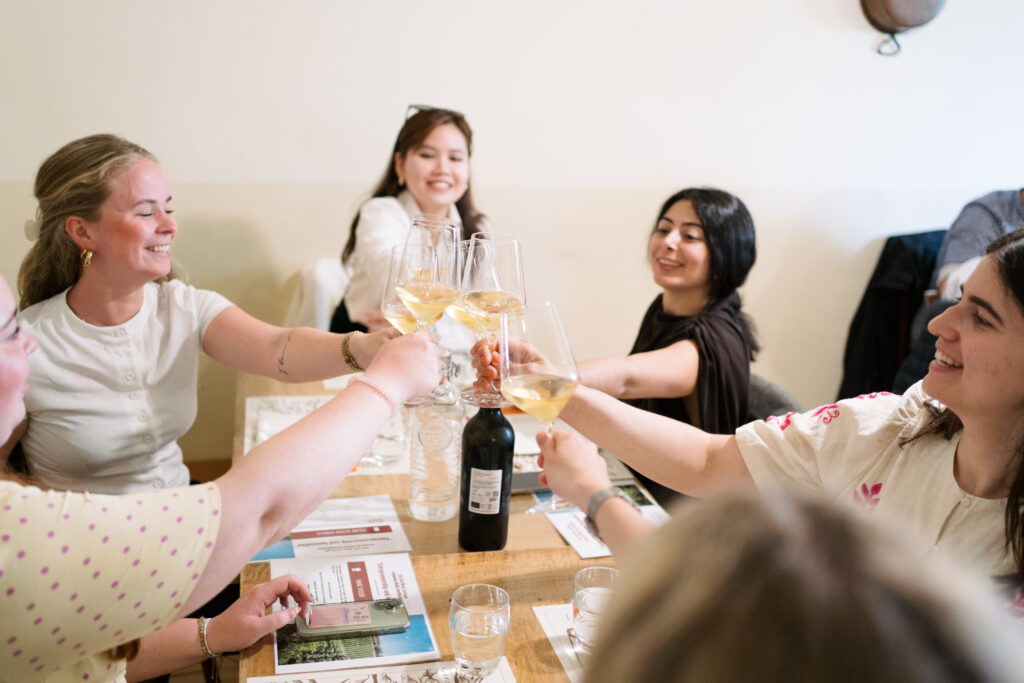
The Italian Food and Wine Experience is one of the core elements of theOffida Approach. It helps international students discover authentic Italy through food, wine and local traditions. Instead of learning only in the classroom, students experience Italian culture every day. As a result, they gain a deeper understanding of Italian food, wine and entrepreneurship.
The experience takes place inOffida, a town famous for its wine and olive oil production. TheMarcheRegion is Italy’s leading area for organic viticulture. Moreover, the province of Ascoli Piceno has the highest percentage of organic vineyards in the region.
This learning journey is made possible through the partnership between i-strategies andCiù Ciù Tenimenti, one of the leading wine producers in Central Italy.
Daily Learning Lunches
Every day, students enjoy lunch at the Ciù Ciù Showroom in Piazza del Popolo, in the historic center of Offida. Lunch is included in the course fee.
Traditional dishes prepared by an Italian chef introduce students to the flavors of the Marche region. At the same time, guided tastings of DOC wines help them discover local wine production. Students who do not drink alcohol can always choose high-quality non-alcoholic alternatives.
However, lunch is much more than a meal. It becomes an important part of the Italian Food and Wine Experience. Students learn about regional recipes, traditional pasta, local ingredients and Italian food culture in a relaxed and interactive environment.
Inside the Winery
The Italian Food and Wine Experience continues with a visit to Cantine Offida, the winery of Ciù Ciù Tenimenti.
First, students explore every stage of wine production during a guided tour in English. Next, they discover how grapes become wine through simple explanations, educational info-graphics and interactive learning cards.
Then, they follow the complete production process. They learn about grape selection, fermentation, aging and bottling. At the same time, they discover how innovation and sustainability support high-quality wine production.
As a result, students understand not only how wine is produced but also why wine plays such an important role in Italian culture and business.
Wine Escape Room
The Italian Food and Wine Experience also includes the Wine Escape Room.
Students work in teams inside the historic Palazzo Mercolini-Tinelli. While solving puzzles, they discover the ancient ice cellar and barrel room. At the same time, they learn about the long history of wine in the Marche region.
Moreover, the activity promotes responsible wine consumption. Students reflect on moderation, the risks of alcohol abuse and the cultural value of wine. Therefore, the activity celebrates wine culture rather than encouraging alcohol consumption.
Italian Food and Wine Experience at an Organic Olive Oil Farm
The Italian Food and Wine Experience also introduces students to extra virgin olive oil.
During the programme, students visitConca d’Oro, a family-run organic olive farm in Appignano del Tronto.
First, they walk through the olive groves while enjoying the surrounding landscape. Next, they visit the olive mill, where the Alessandrini family explains every stage of olive oil production.
Finally, students take part in a guided tasting session. As a result, they learn how to recognize the quality, aroma and flavor of authentic organic extra virgin olive oil.
Gelato Laboratory
No Italian Food & Wine Experience would be complete without authentic Italian gelato (ice-cream).
Students visit the artisan laboratory ofAmor di Gelato. There, master gelato maker Emiliano explains the secrets behind traditional Italian gelato.
First, students discover how ingredients are selected. Then, they learn about preparation, pasteurization, maturation and production. Finally, they understand how craftsmanship, science and entrepreneurship come together to create one of Italy’s best-known food products.
More Than an Italian Food and Wine Experience
The Italian Food and Wine Experience is much more than a culinary programme. It combines learning lunches, company visits, guided tastings, farm experiences, artisan workshops and educational games.
As a result, students do not simply observe Italian traditions. Instead, they experience them directly. Consequently, they develop a deeper understanding of Italian food, wine, culture and entrepreneurship while living in an authentic local community.